

Get Free Consultation!
We are ready to answer right now! Sign up for a free consultation.
I consent to the processing of personal data and agree with the user agreement and privacy policy
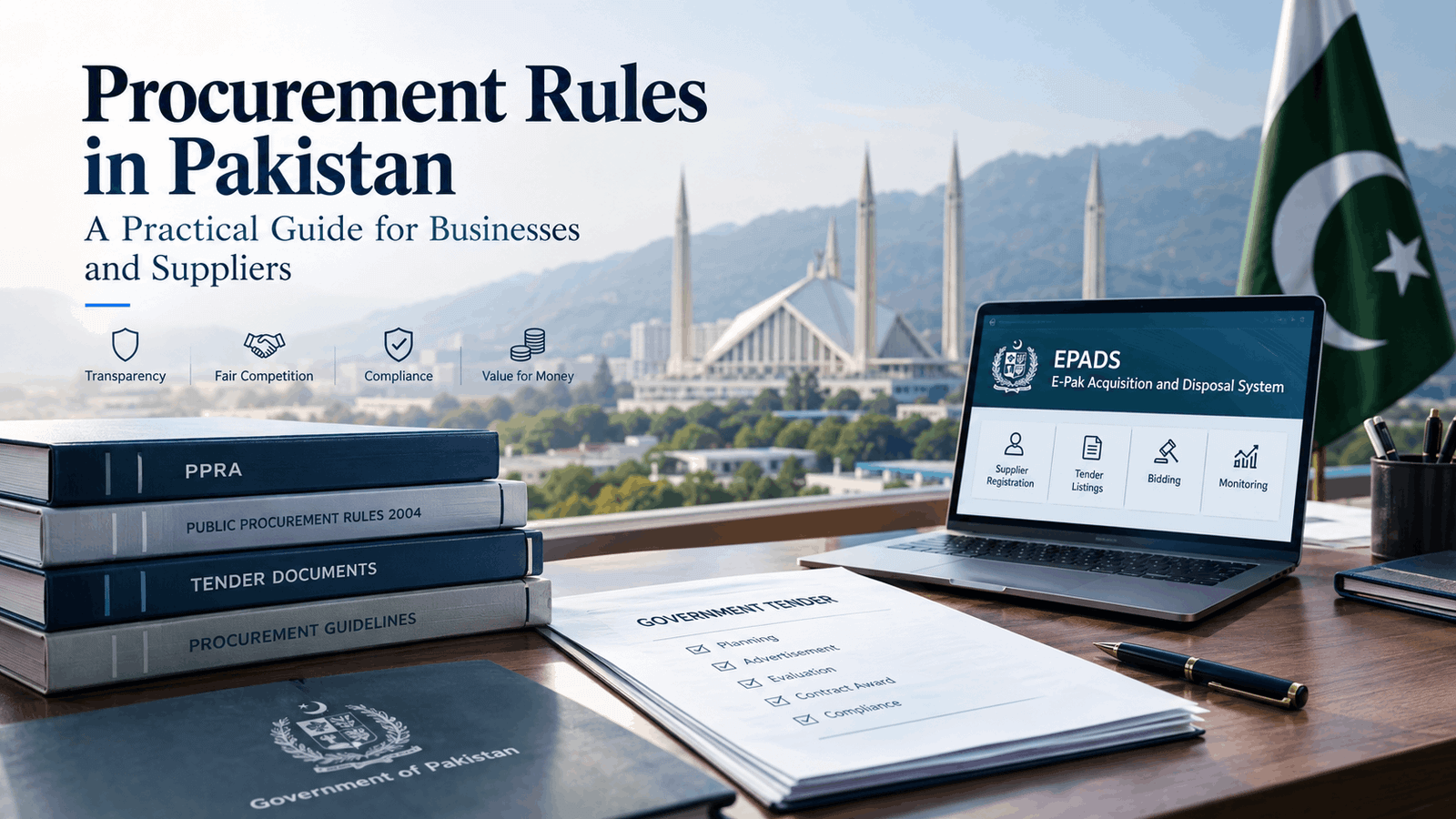
It is critical for the suppliers, contractors, and consultants that are working with government departments to understand Pakistan’s procurement procedures, since these procurement rules Pakistan provide for fair transparency, accountability, and value for money, and they form the core of all government procurement rules Pakistan follows. Ignoring them can lead to costly mistakes and unnecessary delays.
Public Procurement Regulatory Authority (PPRA) is the regulating body for federal procurement under Public Procurement Rules 2004 (including any amendments thereto) that provide for planning, advertising, tendering, evaluation, contract award, documentation, and complaints. These PPRA procurement rules and public procurement rules Pakistan make sure every government tender rules Pakistan process stays fair and competitive, giving honest suppliers a reliable path to successful bids, while risky shortcuts often end in rejection. Public Procurement Rules Pakistan 2004 – PPRA
Public Procurement Regulatory Authority (PPRA) or PPRA is an authority which makes sure that the procurement procedures of the government organizations in Pakistan are conducted in a transparent and efficient way. It develops procurement policy, regulation, standard tender documentation, tender advertisement, procurement guidance and procedure for making complaints regarding the procurement process.
Businesses participating in government tenders are required to regularly read the latest PPRA updates, bidding documentation, procurement notices and procurement regulations before bidding.
The acquiring firms shall state the required products or works or services, budget estimates and the way of purchasing so that the requirements are stated before the acquisition is undertaken.
Proper planning helps government institutions to avoid delays, duplicate purchase and splitting of requirements artificially.
The most prevalent type of procurement according to the Public Procurement Rules, 2004 is the open competitive bidding which allows the competition for business among eligible suppliers and contractors on an open platform.
The tender document should contain the description of the works that are going to be carried out, technical specification, qualification, submission deadline, evaluation process, and terms of the contract. All these aspects should not be needlessly complicated or favor one particular tenderer.
Procurement opportunities are normally advertised through the proper official channels for the case and the campaigns should contain sufficient information for interested vendors to understand the requirement and to submit their proposals.
The PPRA also has regulations and standard formats concerning procurement advertisements, including the updated requirements for public notices and bidding information. Regulations | PPRA :: Public Procurement Regulatory Authority
If the purchase involves a complicated and specialized procurement process, then prequalification will be used to assess the technical competence, financial soundness, and performance of the supplier.
It is very important for them to make sure that the profiles, taxes, licensing, financial records, and technical credentials of their firm are up-to-date and accurate.
That’s technical compliance, cost, delivery schedule, experience, and quality; plus whatever else the procuring authority has defined.
Nor will the lowest price do the trick either. In most cases, the contract will go to the party that satisfies the conditions and offers the greatest value, not merely the lowest quote.
Any corrupt behavior, fraud, coercion, and collusion is not allowed from the bidding participants. This will help the participants give their relevant information without any conflict of interest.
Others get into further detail – Integrity agreement, Tax documents, NTN number, Tender history of the company, who really owns the company. The PPRA has regulations and standard documents for all of this: Regulations | PPRA :: Public Procurement Regulatory Authority
Pakistan’s building out e-procurement through EPADS — the e-Pak Acquisition and Disposal System. One platform now handles supplier registration, tender listings, bidding, and monitoring.
Want a government contract? Register early, keep your paperwork current — that’s the short version. PPRA’s got the full rules in the E-Pak Procurement Regulations, 2023: Regulations | PPRA :: Public Procurement Regulatory Authority
Before submitting a bid, suppliers should:
A robust procurement policy enables businesses to manage quotations, the choice of suppliers,provals, documentation, delivery, quality inspections, and payments in an organised manner. Those companies which supply government departments should ensure that their internal procedures are in line with the relevant laws, the terms of the tender, their tax obligations, and the requirements specific to the sector.
Rules shift, and federal versus provincial systems don’t always line up. Check what applies to your specific agency, province, project, or contract before you submit anything.
Pakistan has certain laws for procurement in place that give an effective framework for transparent purchase and competitive practices, and these public procurement rules Pakistan are the base for every government tender. Suppliers who want to have higher chances of participating effectively in public procurement need to know about the requirements of PPRA, watch the notices, document and follow the bidding guidelines carefully, including the government tender rules Pakistan that apply to each bid.
If a company wants to get acquainted with the latest procurement regulations Pakistan, the typical tender documentation and the notice of procurement, it needs to consult official PPRA procurement rules resources prior to any further steps. Regulations | PPRA :: Public Procurement Regulatory Authority
PPRA stands for Public Procurement Regulatory Authority, and it is responsible for regulating and facilitating the process of transparent and efficient public procurement for the organizations belonging to the federal government. Its procurement rules Pakistan framework sets the standards that government departments and bidders must follow.
The main federal legislation comprises Public Procurement Rules of 2004, amendments to those rules, regulations, standard tender documents and procurement guidelines.
Open competitive bidding is the main mode of procurement, but other modes of procurement are available as well in accordance with the procurement rules and regulations. These tender documents and regulations should always be referred to.
It is necessary for a firm to follow all the tender notices issued officially, make all the needed registrations, prepare the required compliance documents, meet the required technical conditions and submit its bid before the specified date.

